Knowledge
Security is not only the future value of YSMETER, but also the core interest that YSMETER brings to customers
Jun. 02,2026
Share:
Control valves play a critical role in modern industrial processes. Whether used in petrochemical plants, power generation facilities, water treatment systems, or chemical processing operations, a properly selected control valve helps maintain process stability, improve efficiency, and reduce operating costs.
However, selecting the right control valve is not always straightforward. Different applications require different valve structures, actuator configurations, materials, and performance characteristics. Understanding these factors can help engineers, contractors, and purchasing teams make better decisions when evaluating industrial valve solutions.
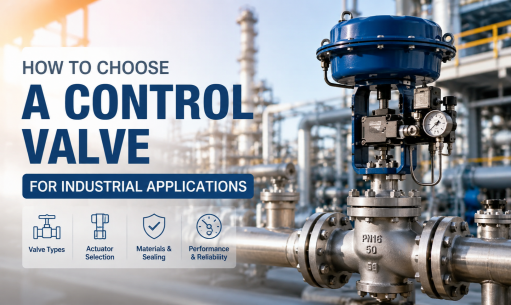
As an experienced industrial valve manufacturer, YSMETER provides a wide range of control valve solutions designed for demanding industrial environments. This guide outlines the most important considerations when selecting a control valve.
The first step in control valve selection is understanding the process itself. Every system operates under different conditions, and those conditions determine which valve design will perform most effectively.
Important parameters include operating pressure, temperature range, flow rate, pressure drop, media composition, and required control accuracy. Applications involving steam, corrosive chemicals, LNG, or abrasive fluids may require specialized valve materials and sealing solutions.
Before evaluating valve options, engineers should establish clear operating parameters to ensure compatibility between the valve and the process conditions.
Industrial control valves are available in multiple configurations, each designed for specific control requirements. Globe-style control valves are among the most commonly used solutions because they provide excellent throttling performance and precise flow regulation.
Single-seat control valves are often selected when tight shutoff performance and accurate control are required. Other designs may be preferred for applications involving larger flow capacities, severe service conditions, or high differential pressures.
When comparing available industrial valve products, users should focus on the actual performance requirements rather than selecting solely based on pipeline size or initial cost.
Actuator selection is one of the most important decisions in the valve selection process. The actuator determines how the valve responds to control signals and directly affects system performance.
A pneumatic control valve uses compressed air as its power source. Pneumatic actuators are widely used in industrial facilities because of their fast response speed, reliable operation, and suitability for hazardous environments.
An electric control valve uses an electric actuator to position the valve. Electric actuators offer convenient integration with automation systems and are often selected where compressed air is unavailable or where digital control is preferred.
The choice between pneumatic and electric actuation should be based on site conditions, response requirements, maintenance considerations, and overall automation strategy.
Material selection directly impacts valve reliability and service life. Carbon steel, stainless steel, alloy steel, and specialty materials are commonly used depending on operating conditions.
Corrosive media may require stainless steel or special alloys. High-temperature and high-pressure systems often demand materials capable of maintaining mechanical strength under extreme conditions. LNG and cryogenic applications require materials that can withstand very low temperatures without losing toughness.
Proper material selection helps prevent premature wear, leakage, and unexpected failures during operation.
The flow characteristic of a control valve determines how flow changes relative to valve travel. Common flow characteristics include linear, equal percentage, and quick opening designs.
Equal percentage characteristics are frequently used in industrial process control because they provide stable regulation over a wide operating range. Linear characteristics may be more appropriate for systems where process gains remain relatively constant.
Selecting the correct flow characteristic improves control accuracy and contributes to more efficient plant operation.
Long-term reliability should always be considered during valve selection. Even the most advanced control valve will eventually require inspection, maintenance, or replacement of wear components.
Engineers should evaluate factors such as maintenance accessibility, spare parts availability, sealing design, and manufacturer support. Selecting a valve that is easy to maintain can significantly reduce lifecycle costs.
Regular maintenance also helps maintain control accuracy and extends equipment service life.
The quality of the manufacturer is just as important as the quality of the valve itself. A reputable control valve manufacturer should provide technical support, product documentation, testing capabilities, and assistance throughout the project lifecycle.
Experienced suppliers can help customers select appropriate valve configurations, identify potential operational risks, and ensure compliance with industry standards and project specifications.
For complex applications involving petrochemical processing, LNG facilities, power generation, and water treatment systems, technical consultation during the selection stage often prevents costly mistakes later in the project.
Choosing the right control valve requires careful evaluation of operating conditions, valve type, actuator selection, material compatibility, flow characteristics, and maintenance requirements.
By understanding these factors and working with a reliable control valve manufacturer, industrial users can improve process performance, increase operational reliability, and reduce long-term operating costs.
If you are looking for industrial control valve solutions or need assistance selecting the right valve for your application, please visit our product center or contact us for technical support.
More News

RELATED PRODUCTS
Security is not only the future value of YSMETER, but also the core interest that YSMETER brings to customers

YSIQ(D)10 Intelligent Single-Seat Control Valve
This valve features a modular design with high versatility and interchangeability, and a compact structure.
View More
YSIQ(D)10F Intelligent Fluoroplastic-Lined Single-Seat Control Valve
YSIQ(D)10F Series Pneumatic/Electric Intelligent Fluorine-Lined Single-Seat Control Valves: These valves are a National Torch Plan Project of 2010 and hold a number of national patents.
View More
YSIQ(D)10S Series Micro-Flow Control Valve
The YSIQ(D)10S series micro-flow control valve is a small-sized valve developed by our company for laboratories and research institutes, characterized by its lightweight and compact structure.
View More
YSIQ(D)20 Pressure-Balanced Single-Seat Control Valve
This valve adopts a modular design with high versatility and interchangeability, and features a compact structure.
View More
YSIQ(D)30 Intelligent Cage-Type Control Valve
This valve adopts a modular design with strong versatility and interchangeability, featuring a compact structure.
View More