Knowledge
Security is not only the future value of YSMETER, but also the core interest that YSMETER brings to customers
Jul. 08,2026
Share:
If your plant runs on compressed air, chances are a pneumatic control valve is already doing some of the heaviest lifting in your process — and choosing the wrong one, or the wrong supplier for it, is an expensive mistake to find out about after startup. This guide explains what a pneumatic control valve is, how it actually works, where it's used, and — most importantly — what to check before you commit to a manufacturer.
A pneumatic control valve is a control valve that uses compressed air as its actuating medium to adjust the flow of a fluid or gas by changing the size of the flow passage, typically in response to a signal from a controller or process system. In practice it's an assembly of two parts working together: the valve body (which handles the process media) and the actuator.
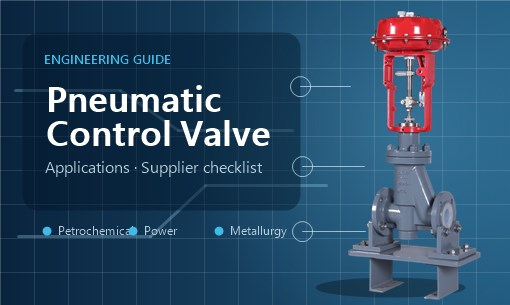
How the actuator moves the valve. Compressed air is fed into the actuator, where it acts on a diaphragm or piston. A common configuration is "air-to-close, spring-open": air pressure (often around 6 bar / 87 psi) pushes the diaphragm down to close the valve, while air is bled off the line to let return springs push it back open — which means the valve's fail-safe position on loss of air supply is open. There are two broad actuator families:
Common valve body types used with pneumatic actuation, each suited to different service requirements:
Most pneumatic control valves are also fitted with a position indicator — a simple visual cue (green or yellow for open, red for closed, or the letters O/S) so operators can confirm valve status at a glance without instrumentation.
Pneumatic actuation is the default choice wherever a plant needs fast, reliable, and — critically — explosion-safe flow control, which is exactly why it shows up so often in:
It also shows up widely in water treatment, food and beverage, and pharmaceutical production — but for engineers specifying valves for petrochemical, power, or metallurgical service, the deciding factor is almost always the same: pneumatic actuation doesn't need an electrical circuit at the point of actuation, so there's no ignition risk in classified hazardous areas, and the mechanism keeps working reliably even in dusty, high-vibration, or extreme-temperature environments where electric actuators struggle.
The valve itself is only half the decision — the manufacturer behind it determines whether that valve is still performing correctly in year five. Here's what to verify before you sign a purchase order.
Ask for committed lead times in writing, not just a verbal estimate, and ask what happens to your delivery date if a component (actuator, positioner, specialty trim material) is on backorder. A manufacturer who can show you real production scheduling — rather than a generic "4-6 weeks" — is one who has actually mapped their own supply chain risk.
The valve body, trim, and seals directly determine whether the valve holds pressure safely over its service life. Ask which mill certificates (MTRs) are provided with each shipment, what material traceability looks like from raw casting to finished valve, and whether pressure/seat testing is done on every unit or only on a sampling basis.
Don't take a certification badge on a website at face value — ask for the actual certificate number and check it against the issuing body's public registry where one exists. For API-relevant valves, confirm which API standard applies (e.g., API 6D for pipeline valves) and ask whether the specific product line — not just the company in general — is covered under that certification.
Pneumatic actuators need periodic maintenance — diaphragm and spring replacement, positioner calibration, packing adjustment — and a supplier who can't support that after the sale is a long-term liability, not a bargain. Ask what documentation ships with the valve (installation, maintenance, troubleshooting guides), whether spare parts are stocked for existing valve lines, and how technical support is actually reached when something goes wrong in the field.
Before you request a quote, it's worth putting the manufacturer through a short screening pass. At minimum, ask for:
If a supplier can answer all five without hesitation, that's a strong signal they're set up to support you for the life of the valve — not just through the first shipment.
Is a pneumatic control valve the same as a pneumatic actuator?
No — the actuator is just the component that converts air pressure into mechanical motion. The pneumatic control valve is the complete assembly: valve body plus actuator plus any positioner or accessories.
What air pressure do pneumatic control valves need?
It varies by design, but many spring-diaphragm actuators operate around 6 bar (87 psi), with a positioner often working on a lower control signal range (commonly 3–15 psi) to modulate the main air supply precisely.
What happens to a pneumatic control valve if the air supply fails?
That depends on the actuator design. Spring-return (single-acting) actuators are built with a defined fail-safe position — commonly fail-open or fail-closed depending on the application — while double-acting actuators typically need a separate mechanism (like a volume tank or solenoid dump valve) to reach a safe state on air loss.
Why choose pneumatic over electric actuation?
Pneumatic actuation avoids electrical sparking risk in classified hazardous areas, tends to be simpler and cheaper to maintain in the field, and performs reliably in high-vibration or extreme-temperature environments — though electric actuators can offer finer positioning control where that's the priority instead.
More News