Knowledge
Security is not only the future value of YSMETER, but also the core interest that YSMETER brings to customers
Jul. 01,2026
Share:
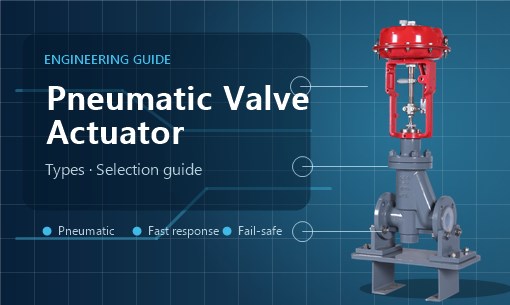
A pneumatic valve actuator converts compressed air into the mechanical force that opens, closes, or throttles an industrial valve — no motor, no manual wheel, just air pressure acting on a piston, diaphragm, or vane. It's the reason a process control system can shut a line down in milliseconds without anyone standing next to it, and it's the default automation choice anywhere a spark risk from electrical equipment isn't acceptable.
When compressed air enters the actuator, it acts on an internal piston, diaphragm, or vane, converting that air pressure into either linear motion (for globe, gate, or plug valves) or rotary motion (for ball or butterfly valves). A built-in spring-return mechanism is a common safety feature: it drives the valve back to a defined position the moment air pressure is lost, which is exactly why pneumatic actuators show up so often in emergency shutdown systems.
| Actuator Type | Key Features | Advantages | Typical Applications |
|---|---|---|---|
| Diaphragm | Flexible diaphragm, compact design | Low maintenance, precise control | Control valves (globe, plug) |
| Piston | Piston in a cylindrical chamber | High torque, durable, handles >10 bar | Gate, ball, butterfly valves |
| Rack and Pinion | Gear system converts linear to rotary motion | Constant torque output, compact | Ball, butterfly valves |
| Vane | Rotor with vane produces rotary motion | Compact, cost-effective | Light-duty, space-constrained tasks |
| Scotch Yoke | Yoke mechanism converts linear to rotary motion | Highest torque, especially at stroke start/end | Large gate valves, heavy-duty service |
Diaphragm and piston actuators drive linear (up-and-down) motion; rack-and-pinion, vane, and scotch yoke actuators drive quarter-turn rotary motion. As a rough guide to real-world numbers: one manufacturer's quarter-turn actuator line rates double-acting units from 195 up to 28,500 in.lbs of torque and spring-return units from 50 up to 16,500 in.lbs at 80 psig supply pressure, with a -30°F to 300°F temperature range and operating speeds from 0.3 to 6 seconds depending on model — useful as a sense of the range you should expect to see on a real datasheet, not a spec to assume applies to every actuator.
The actuator itself doesn't decide when to move — a separate pneumatic directional control valve routes compressed air to and from it, and these are classified along three dimensions: the number of ports (2-way, 3-way, or 4-way), the resting state (normally open or normally closed when de-energized), and whether a spring-offset mechanism returns it to its original position. Single-acting (spring-return) actuators are typically driven by a 3-way control valve — pressurize one side, then vent it and let the actuator's internal spring push it back. Double-acting actuators need a 4-way (or 5-way) control valve, since air has to be actively directed to alternate sides of the piston or diaphragm to drive it both open and closed.
It's easy to conflate these two terms. A pneumatic control valve is the complete assembly — valve body plus actuator plus any positioner — and questions around it tend to be commercial (which manufacturer, what certifications, what lead time). A pneumatic valve actuator is specifically the drive component, and the questions here are mechanical: which actuator type fits the valve and duty cycle, single-acting or double-acting, what torque is actually required. Both topics matter, but they answer different questions — see our companion guide for the supplier-selection side, or our main guide to valve actuators for how pneumatic actuators compare to electric, hydraulic, and manual options.
Pneumatic actuators respond faster, cost less up front, run at a 100% duty cycle, and — because there's no electrical circuit at the point of actuation — carry no spark risk in classified hazardous areas, which is why they dominate in oil & gas, chemical processing, and power generation. Electric actuators offer more precise positioning and easier remote data logging, but are typically slower, often limited to a lower duty cycle, and need additional explosion-proof certification for hazardous-area use. If your plant already has a reliable compressed-air supply and the application involves any hazardous-area classification, pneumatic is usually the simpler and cheaper path.
Confirm your available supply pressure against the actuator's rated range (commonly somewhere in the 35–150 psig band, model-dependent), decide whether the application needs single-acting (spring-return, for a defined fail-safe position) or double-acting (for applications with no inherent need for a fail-safe position), and check the required operating speed — actuator response times can range from a fraction of a second to several seconds depending on model and valve size.
Actuator-to-valve mounting is standardized under ISO 5211, and many pneumatic actuators are built with a NAMUR-standard solenoid mounting pad so a directional control valve can be direct-mounted without custom brackets — checking for both on a datasheet is a quick way to confirm an actuator will actually bolt up to your valve and control components without a special adapter.
Beyond the mounting interface, it's worth pressure-testing a supplier the same way you would for the valve itself: ask for the actual certificate number behind any ISO or hazardous-area claim (not just a badge on a website), confirm it covers the specific actuator model rather than the company in general, ask what committed lead time they'll put in writing, and ask how after-sales support works if a seal or spring needs replacing years into service. A manufacturer who can answer all four clearly is a much safer long-term bet than one who can only point to a general "ISO certified" claim.
Pneumatic valve actuators are the standard choice in oil & gas and petrochemical processing, where explosion safety and fast response on shutoff valves matter most, and in power generation, where they regulate steam, cooling water, and process air across systems that need to keep running reliably around the clock.
What's the difference between a pneumatic valve actuator and a pneumatic control valve?
The actuator is just the drive component that converts air pressure into motion. A pneumatic control valve is the complete assembly — valve body, actuator, and often a positioner — and buying decisions around it are more about supplier certification and lead time than actuator mechanics.
Single-acting or double-acting — which one do I need?
Choose single-acting (spring-return) when the application needs a guaranteed fail-safe position if air is lost — most emergency shutoff duty falls here. Choose double-acting when there's no safety requirement to reach a specific position on air loss and you want equal force in both directions, typically for general on/off or throttling duty where fail-safe position isn't a factor.
Do pneumatic actuators need certification for hazardous areas?
Pneumatic actuators have an inherently easier path to hazardous-area approval than electric actuators because there's no electrical circuit at the point of actuation, but they still need to meet the mounting (ISO 5211) and, depending on the region, ATEX or equivalent explosion-safety requirements for the overall assembly — don't assume "pneumatic" alone is a certification.
More News

RELATED PRODUCTS
Security is not only the future value of YSMETER, but also the core interest that YSMETER brings to customers

YSIQ(D)50 Intelligent Three-Way Control Valve
This valve adopts a modular design with strong versatility and interchangeability, featuring a compact structure.
View More
YSIQ(D)70 Intelligent High-Pressure Control Valve
The YSIQ(D)70 series pneumatic/electric intelligent high-pressure control valves feature a unique design and special hardening treatment
View More
YSIQD Cryogenic Pneumatic Control Valve
YSID10/20 Series Pneumatic/Electric Intelligent Cryogenic Control Valves: These valves are a National Torch Plan Project of 2010 and hold a number of national patents.
View More