Knowledge
Security is not only the future value of YSMETER, but also the core interest that YSMETER brings to customers
Jul. 03,2026
Share:
If your piping system has a pump, a compressor, or anything that could push fluid backward when it stops, you almost certainly need a check valve there — and the swing check valve is the design most engineers reach for first. This guide covers how a swing check valve actually works, where it holds up best in industrial service, and what to check on a manufacturer's spec sheet before you order one.
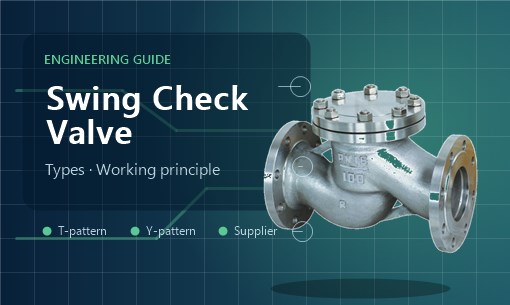
A swing check valve is one of the simplest valve designs in a piping system: a hinged disc (sometimes called a clapper) hangs inside the valve body on a pin, with only two or three moving parts in total. Forward flow pushes the disc open and out of the way; when flow stops or reverses, gravity swings the disc back down onto the seat and blocks backflow. There's no external power source and nothing to actuate — the valve runs entirely on the fluid's own pressure and the disc's own weight.
The disc is mounted to a hanger arm that pivots around a hinge pin positioned outside the disc's own edge. As flow enters, it lifts the disc off the seat and rotates it out of the flow path with very little turbulence or pressure drop. When the pump shuts off or flow reverses, the same hinge geometry lets the disc fall — or get pushed — back onto the seat, sealing the line before flow can run backward through it.
This is the one detail that trips up more installations than anything else: a swing check valve has to be installed either horizontally, or vertically with flow moving upward. It cannot be installed upside down, on its side, or in a line where flow moves downward — in that orientation the disc simply hangs open under its own weight instead of resting on the seat, and the valve stops protecting against backflow entirely. Every valve is marked with a flow-direction arrow for exactly this reason, and it's worth confirming orientation against the manufacturer's installation instructions before the line is welded in.
Because the disc closes under gravity rather than under active control, a swing check valve can slam shut abruptly when flow stops suddenly or reverses quickly — especially with slower-moving or more viscous fluids, where the disc lags before a backflow surge snaps it shut. That sudden closure is a classic cause of water hammer: a pressure spike that can produce noise, vibration, and — over enough cycles — damage to pipe supports and fittings. The standard fix is an external hinge arm fitted with a lever weight or an adjustable spring, which controls how fast the disc closes and cushions the impact instead of letting it slam.
A swing check valve is not the same thing as a backflow preventer: a swing check valve simply stops reverse flow to protect equipment, while a backflow preventer combines two check valves with a pressure relief valve and is certified specifically to stop contamination from entering a clean water supply — a different job with a different certification path. Compared with a ball check valve, which seats a free-floating ball against the flow, a swing check valve gives a lower pressure drop and is generally cheaper, but a ball check valve can be installed in more orientations and handles viscous or particulate-laden fluids somewhat better.
Swing check valves show up anywhere a pump or compressor needs backflow protection with minimal added resistance, which is why they're a standard fixture across:
Discharge lines on pumps and compressors handling hydrocarbons need reliable backflow protection without adding meaningful pressure drop to already-demanding process lines — exactly the tradeoff a well-built swing check valve is designed around.
Steam and cooling-water systems rely on swing check valves on pump discharge lines to prevent reverse flow from draining or damaging the system the moment a pump shuts down or trips offline.
Water and wastewater applications are one of the most common use cases for swing check valves, thanks to their simple construction, low pressure drop, and straightforward field serviceability — though the choice between metal and resilient seating (below) matters more here than almost anywhere else.
The valve's basic operating principle is the same across manufacturers — what actually determines whether it performs reliably for years is the design details and the manufacturer standing behind it.
Swing check valves come in two common body patterns, and the difference affects both performance and installation flexibility:
| Feature | T-Pattern | Y-Pattern |
|---|---|---|
| Flow path | Straight | Angled (typically 30–45°) |
| Pressure drop | Higher | Lower |
| Flow efficiency | Lower | Higher |
| Footprint | Smaller | Larger |
| Typical cost | Lower | Higher |
| Installation | Horizontal only | Horizontal or vertical (upward flow) |
T-pattern valves are compact and easy to install and maintain, making them a good fit for horizontal runs with limited space, but they carry a higher pressure loss and aren't ideal for high-flow or high-velocity service. Y-pattern valves cost more and take up more room, but their angled disc geometry gives smoother flow and a lower pressure drop — worth the extra footprint on lines where flow rate and installation flexibility matter more than compactness.
Swing check valves are available with either a metal-to-metal seat or a resilient (elastomer) seat. Resilient seating is generally the better choice for wastewater or any service where dirt, grit, or other particulate may be present in the fluid and a positive, drip-tight shutoff is required — metal seats can struggle to seal fully once debris gets between the disc and seat.
Body material should match the service: carbon steel for general industrial use, stainless steel for corrosive media, and low-temperature or high-temperature steel grades for cryogenic or high-heat applications respectively. Always confirm the valve's rated pressure class against your actual line conditions, not just a generic "industrial grade" claim on a spec sheet.
Reputable manufacturers build swing check valves to recognized design standards such as BS 1868 and API 6D, or to a client's own specification where the application calls for it. Don't take a standard name on a datasheet at face value — ask which specific edition applies and whether it's been verified for the exact model and size you're ordering, not just the product line in general.
A certification badge on a website only tells you so much. Before you commit to a supplier, it's worth pressure-testing them on the things that actually determine whether the valve — and the relationship — holds up over years of service:
These four points map directly onto what most industrial buyers actually get burned by — not the valve failing on day one, but a supplier who can't deliver on time, can't prove their material claims, or goes quiet after the invoice is paid.
Swing check valves aren't the only option for backflow protection, and they're not always the right one. Dual plate check valves use two spring-loaded half-discs instead of one full disc, giving a more compact, lighter-weight design with faster closure — useful where space is tight or where minimizing water hammer matters more than low cost. Tilting disc check valves close faster still, with less slam, and are common in higher-velocity or more demanding services. Axial flow check valves use a spring-loaded poppet moving in line with flow rather than a hinged disc, giving very fast closing response for applications where hydraulic shock control is the top priority. If your application runs at higher velocities, has frequent flow reversals, or can't tolerate any water hammer risk, it's worth comparing these designs against a standard swing check valve before finalizing your spec.
What's the difference between a swing check valve and a ball check valve?
A swing check valve uses a hinged disc and gives a lower pressure drop at lower cost, but it must be installed horizontally or with vertical upward flow only. A ball check valve uses a free-floating ball that seats against the flow, can be installed in more orientations, and tends to handle viscous or particulate-laden fluids somewhat better, at the tradeoff of higher pressure drop.
How do I select the right swing check valve size?
Size to your actual line size and expected flow rate rather than rounding up "to be safe" — an oversized swing check valve won't get enough flow velocity to fully lift the disc, which can cause chattering and premature wear. Confirm the manufacturer's minimum flow velocity requirement for full disc lift against your system's normal operating range.
What maintenance does a swing check valve need?
Very little by design — periodic visual inspection for leaks, debris on the seat, or corrosion is usually enough, plus keeping the seat area clean. Because there's no packing or actuator to service, most maintenance is limited to inspection and, occasionally, seat or hinge-pin replacement after years of cycling.
Why do swing check valves cause water hammer, and can it be prevented?
The disc closes under gravity and reverse-flow pressure rather than under controlled actuation, so a sudden flow stop can snap it shut hard enough to create a pressure spike. An external hinge arm with a lever weight or adjustable spring controls the closing speed and largely eliminates the slam — it's worth asking whether this option is available before ordering for any line with frequent starts and stops.
More News

RELATED PRODUCTS
Security is not only the future value of YSMETER, but also the core interest that YSMETER brings to customers

YSIQ(D)10 Intelligent Single-Seat Control Valve
This valve features a modular design with high versatility and interchangeability, and a compact structure.
View More
YSIQ(D)10S Series Micro-Flow Control Valve
The YSIQ(D)10S series micro-flow control valve is a small-sized valve developed by our company for laboratories and research institutes, characterized by its lightweight and compact structure.
View More