Knowledge
Security is not only the future value of YSMETER, but also the core interest that YSMETER brings to customers
Jul. 07,2026
Share:
A valve actuator is the device that turns a valve open, closed, or to a partial position without a human standing there to do it by hand. Get the actuator type wrong for your application and you end up with a valve that's too slow, too weak, too expensive to maintain, or simply not rated for the area it's installed in — so it's worth understanding the main types before you spec one.
A valve actuator converts an external power source — compressed air, electricity, hydraulic pressure, a stored spring charge, or manual effort — into the mechanical motion that opens, closes, or throttles a valve. In a modern process plant, actuated valves are what let a control system respond automatically to changing conditions, shut a line down in an emergency, or let an operator open a valve remotely without walking out to a hazardous area. The actuator, not the valve body, is usually what determines how fast, how reliably, and how safely that motion happens.
Actuators are generally chosen along two axes: the power source, and whether the valve needs linear motion (up-and-down, for globe, gate, and diaphragm valves) or quarter-turn rotary motion (for ball, butterfly, and plug valves).
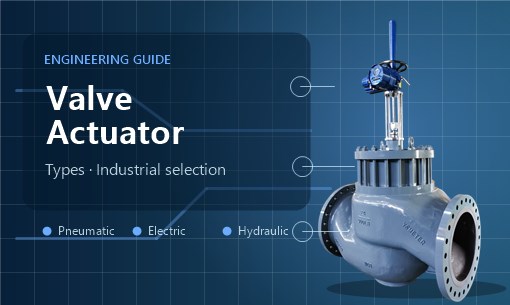
Pneumatic actuators use compressed air acting on a diaphragm or piston, making them the default choice in petrochemical and oil & gas plants: they respond quickly, cost less than electric equivalents, run at a 100% duty cycle without overheating, and — because there's no electrical circuit at the point of actuation — carry no spark risk in classified hazardous areas. The tradeoff is that they need a reliable compressed-air supply, and precision is limited somewhat by the compressibility of air.
Electric actuators use a motor and gearbox, and they're easy to install anywhere there's a stable power supply, support remote operation and data logging, and offer precise positioning. The downsides: they're generally slower than pneumatic actuators, most designs aren't rated for continuous (100% duty cycle) operation, they can be harder to repair in the field, and using them in a hazardous area means sourcing additional explosion-proof certification that pneumatic actuators don't need in the first place.
For heavier-duty service, hydraulic actuators deliver much higher output force and can hold a position for long periods without continuous power, at the cost of higher price and some leak risk — common on large valves in offshore and power-generation settings. Electro-hydraulic actuators (EHA) combine an electric motor with a self-contained hydraulic unit, giving 100% duty cycle and a configurable fail-safe position (fail-open, fail-closed, or fail-last), which is why they show up on offshore drilling equipment and emergency shutdown (ESD) valves — though they're the most expensive and hardest to repair option. Manual actuators (handwheels, levers, gearboxes) are the cheapest and simplest option for valves that operate rarely and don't need automation. Spring actuators store a pre-compressed charge purely to provide a single emergency action if power or air is lost, and need to be manually reset afterward.
A related distinction that matters as much as power source: spring-return (single-acting) actuators use power to drive one direction and a spring to return the other, which gives a defined fail-safe position on loss of power or air — the standard choice for emergency shutoff duty. Double-acting actuators use external power in both directions and have no inherent fail-safe position, so they need an add-on device (a volume tank or solenoid dump valve) to reach a safe state if power is lost.
Start with what the valve actually needs to do: how fast does it need to open or close, does it need to throttle precisely or just switch on/off, what's the ambient temperature and area classification, and is compressed air or reliable electrical power actually available at the installation point? A pneumatic actuator is the default in most petrochemical and power-plant settings specifically because compressed air infrastructure is usually already there and hazardous-area certification is simpler to satisfy.
Actuator specifications reference a specific set of standards, and it's worth knowing them well enough to check a datasheet rather than take a "certified" claim at face value: ISA96.01–96.05 cover actuator terminology and the technical requirements for electric and pneumatic actuators; ISO 22153:2020 covers classification, design, and corrosion protection for electric valve actuators; EN ISO 5210/5211 and DIN 3358 define the mounting-flange dimensions that connect an actuator to a valve; enclosure protection is rated under IP67/IP68 (ingress protection) or NEMA 4/4X; and hazardous-area explosion protection falls under NEMA 7 (for Class I, Division 1 areas in the US) or the regional equivalents — ATEX in the EU, NEC-FM in the US, CEC-CSA in Canada. Pneumatic actuators tend to have an easier path to explosion-proof certification simply because there's no electrical circuit to certify in the first place.
Matching the right actuator type on paper is only half the job — the manufacturer behind it determines whether that actuator is still performing correctly in year five. Before you commit to a supplier, it's worth checking:
These four points are what usually separate a smooth multi-year relationship with a supplier from a purchase order you regret — far more often than the actuator itself failing outright.
Actuated valves are standard equipment across petrochemical and oil & gas processing, where pneumatic actuation dominates thanks to explosion safety and existing compressed-air infrastructure; power generation, where both pneumatic and electric actuators regulate steam, cooling water, and process air across continuously running systems; and metallurgical plants, where actuators need to be simple, robust, and serviceable under high temperatures, particulates, and harsh duty cycles.
What's the difference between a pneumatic and electric actuator?
Pneumatic actuators run on compressed air, respond faster, cost less, and are inherently safer in hazardous areas since there's no electrical spark risk. Electric actuators run on a motor and gearbox, offer more precise positioning and remote data logging, but are typically slower, rated for a lower duty cycle, and need additional certification for hazardous-area use.
How do I size a valve actuator?
Size to the valve's actual required torque or thrust at maximum differential pressure, with a safety margin — not to the valve's nominal pipe size alone. Undersizing an actuator is a common cause of slow or incomplete valve operation; oversizing wastes cost and, for pneumatic actuators, air consumption.
Do actuators need certification for hazardous environments?
Yes, if they're installed in a classified hazardous area. Electric actuators need explosion-proof certification (NEMA 7, ATEX, NEC-FM, or CEC-CSA depending on region) because they carry live electrical components; pneumatic actuators have an inherently easier path to the same certification because there's no electrical circuit at the point of actuation.
More News