Knowledge
Security is not only the future value of YSMETER, but also the core interest that YSMETER brings to customers
Jun. 12,2026
Share:
A control valve actuator converts a control signal into mechanical movement, allowing the valve to regulate flow, pressure, temperature, or liquid level. Selecting the right actuator is an important part of building reliable control valve solutions for demanding industrial processes.
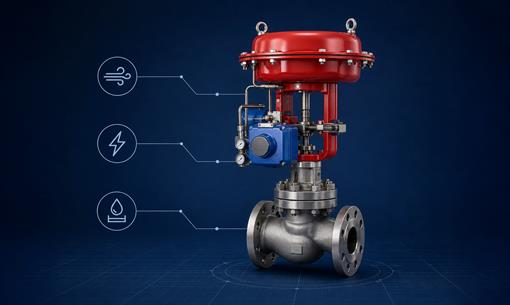
The actuator affects response speed, control accuracy, maintenance requirements, safety behavior, and compatibility with site utilities. In many applications, the valve body and actuator should be evaluated together rather than treated as separate components.
Pneumatic actuators use compressed air to move the valve stem or shaft. They are widely used in petrochemical, chemical, power, and general process industries because they are fast, durable, and suitable for hazardous environments.
A pneumatic actuator is often preferred when plant air is available and fast response is required. It can also be combined with positioners, solenoid valves, air filters, and limit switches to improve control and monitoring.
For applications that require stable modulation, a pneumatic control valve configuration can provide dependable operation with relatively simple maintenance.
Electric actuators use electrical power to drive valve movement. They are commonly selected when compressed air is not available or when integration with electrical control systems is preferred.
Electric actuators are suitable for remote installations, utility systems, water treatment facilities, and applications where slower but precise movement is acceptable.
When selecting an electric actuator valve solution, engineers should consider torque, travel time, enclosure protection, duty cycle, power supply, and fail-safe requirements.
Hydraulic actuators use pressurized fluid to generate high force. They are often used for large valves, high-pressure applications, or systems that require strong thrust and reliable movement under heavy loads.
Although hydraulic systems can deliver excellent force output, they usually require more supporting equipment and maintenance than pneumatic or electric actuators.
Actuator selection should consider control signal, available power source, valve size, required thrust or torque, response speed, environmental conditions, and safety position during power or air failure.
For severe service or high-pressure applications, the actuator must also be matched with the valve trim and body design to ensure stable performance.
Pneumatic, electric, and hydraulic actuators each offer different advantages. The best choice depends on site utilities, process conditions, safety requirements, and control expectations.
If you need help selecting a control valve with the right actuator, visit our Product Center or Contact Us page to discuss your application.
More News

RELATED PRODUCTS
Security is not only the future value of YSMETER, but also the core interest that YSMETER brings to customers

YSIQ(D)30 Intelligent Cage-Type Control Valve
This valve adopts a modular design with strong versatility and interchangeability, featuring a compact structure.
View More
YSIQ(D)50 Intelligent Three-Way Control Valve
This valve adopts a modular design with strong versatility and interchangeability, featuring a compact structure.
View More
ZZYP Self-Operated Pressure Control Valve
The ZZYP series self-operated pressure control valve is an actuator product that requires no external power source
View More
ZZVP Self-Operated Micro-Pressure Control Valve
The ZZVP series self-operated micro-pressure control valve is an actuator product that requires no external energy source
View More