Knowledge
Security is not only the future value of YSMETER, but also the core interest that YSMETER brings to customers
Jun. 03,2026
Share:
Control valves are essential components in modern process automation systems. Whether regulating flow, pressure, temperature, or liquid level, the performance of a control valve directly affects production efficiency, process stability, and equipment safety.
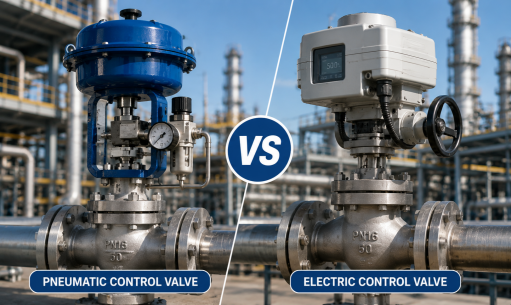
Among the most common configurations, pneumatic control valves and electric control valves are widely used across industries such as petrochemical processing, power generation, water treatment, pharmaceuticals, and EPC projects. While both perform the same basic function, their operating principles, advantages, and ideal applications can differ significantly.
As an experienced industrial valve manufacturer, YSMETER provides a variety of control valve solutions designed for demanding industrial environments. Understanding the differences between pneumatic and electric control valves can help engineers and procurement teams select the most suitable solution for their projects.
A pneumatic control valve uses compressed air to drive the actuator and position the valve according to control signals. Pneumatic actuation has been widely adopted in industrial plants for decades due to its reliability, fast response speed, and suitability for hazardous environments.
Most pneumatic control valves consist of a valve body, actuator, positioner, air supply system, and control accessories. The actuator converts air pressure into mechanical movement, allowing precise regulation of process variables.
Examples of pneumatic control valve solutions can be found in the Control Valve Series, including specialized products such as the YSIQ-D-10 Intelligent Single Seat Control Valve.
An electric control valve uses an electric actuator powered by electricity to move the valve stem or shaft. The actuator receives electrical control signals and adjusts the valve opening accordingly.
Electric control valves are often selected when compressed air is unavailable or when direct integration with digital control systems is required. Modern electric actuators can provide accurate positioning and support advanced communication protocols used in industrial automation.
In facilities with extensive automation infrastructure, electric control valves may simplify installation by eliminating the need for compressed air piping.
Pneumatic control valves remain the preferred solution in many industrial applications because of their simplicity and reliability.
One major advantage is response speed. Pneumatic actuators can react quickly to changing process conditions, making them suitable for demanding control loops.
Another benefit is safety. Since compressed air is the driving force, pneumatic systems can operate safely in explosive or hazardous environments where electrical equipment may require additional protection.
For high-pressure applications, products such as the YSIQ-D-70 Intelligent High Pressure Control Valve demonstrate how pneumatic control solutions can provide reliable performance under challenging operating conditions.
Electric control valves offer several advantages, particularly in facilities focused on automation and digital monitoring.
Electric actuators can provide precise positioning accuracy and are often easier to integrate with distributed control systems (DCS), PLC systems, and smart factory platforms.
Because no compressed air system is required, installation can be simplified in certain applications. This can reduce infrastructure costs in smaller facilities or remote installations.
Electric actuators also allow operators to monitor operating status remotely and collect valuable performance data for predictive maintenance programs.
When comparing pneumatic and electric control valves, engineers should evaluate several important factors.
Response Speed: Pneumatic control valves generally provide faster response times.
Automation Integration: Electric control valves often integrate more easily with modern digital control systems.
Hazardous Areas: Pneumatic systems are frequently preferred in explosive environments.
Maintenance Requirements: Pneumatic systems require compressed air infrastructure, while electric actuators may require less auxiliary equipment.
Power Availability: Facilities without reliable compressed air systems may benefit from electric solutions.
The ideal solution depends on the specific application rather than a universal preference for one technology over another.
Industries such as petrochemical processing, refining, LNG facilities, and power generation often continue to favor pneumatic control valves because of their proven reliability and safety performance.
For specialized applications such as cryogenic service, solutions like the Cryogenic Pneumatic Control Valve are designed to handle extremely low operating temperatures while maintaining stable control performance.
Organizations seeking support for project design, valve selection, and engineering consultation may also benefit from YSMETER's Engineering Services.
Both pneumatic and electric control valves play important roles in industrial automation systems. Pneumatic control valves excel in hazardous environments, high-speed applications, and heavy-duty industrial processes, while electric control valves offer advantages in automation integration and simplified installation.
The best choice depends on operating conditions, control requirements, safety considerations, and available infrastructure.
If you are evaluating control valve solutions for an upcoming project, visit our Product Center or Contact Us to discuss your application requirements with our technical team.
More News

RELATED PRODUCTS
Security is not only the future value of YSMETER, but also the core interest that YSMETER brings to customers

YSIQ(D)10 Intelligent Single-Seat Control Valve
This valve features a modular design with high versatility and interchangeability, and a compact structure.
View More
YSIQ(D)10F Intelligent Fluoroplastic-Lined Single-Seat Control Valve
YSIQ(D)10F Series Pneumatic/Electric Intelligent Fluorine-Lined Single-Seat Control Valves: These valves are a National Torch Plan Project of 2010 and hold a number of national patents.
View More
YSIQ(D)10S Series Micro-Flow Control Valve
The YSIQ(D)10S series micro-flow control valve is a small-sized valve developed by our company for laboratories and research institutes, characterized by its lightweight and compact structure.
View More
YSIQD Cryogenic Pneumatic Control Valve
YSID10/20 Series Pneumatic/Electric Intelligent Cryogenic Control Valves: These valves are a National Torch Plan Project of 2010 and hold a number of national patents.
View More