Knowledge
Security is not only the future value of YSMETER, but also the core interest that YSMETER brings to customers
Jun. 05,2026
Share:
Control valves are among the most important components in industrial process control systems. Selecting the correct valve design can significantly improve process stability, control accuracy, and equipment reliability. Among the many control valve configurations available today, single seat control valves and cage guided control valves are two of the most widely used options.
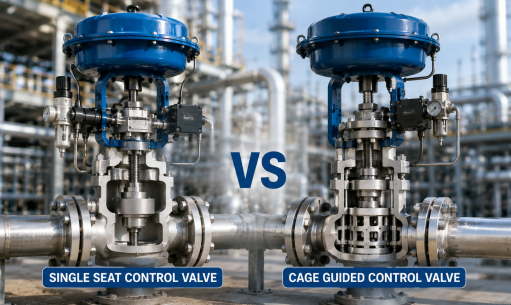
Although both designs serve the same purpose of regulating flow and process variables, their internal structures, pressure handling capabilities, and application suitability can vary considerably. Understanding these differences helps engineers, EPC contractors, and plant operators make informed decisions when selecting industrial control valves.
As a professional industrial valve manufacturer, YSMETER offers a complete range of intelligent control valve solutions designed for various industrial applications. This article compares single seat and cage guided control valves to help users choose the most suitable option.
A single seat control valve uses one plug and one seat to regulate flow. The design provides excellent shut-off performance and high control accuracy, making it one of the most common valve types in industrial automation systems.
The relatively simple structure makes maintenance easier while offering stable throttling performance under normal operating conditions. Single seat control valves are widely used in chemical processing, pharmaceutical production, water treatment, and general industrial applications.
A typical example is the YSIQ-D-10 Intelligent Single Seat Control Valve, which is designed for precise flow regulation and reliable process control.
A cage guided control valve incorporates an internal cage structure that guides the movement of the valve plug. This design improves valve stability and helps distribute flow forces more evenly throughout the valve body.
Because the cage supports the plug during operation, cage guided control valves are often preferred for applications involving high pressure differentials, severe service conditions, and demanding control requirements.
YSMETER's YSIQ-D-30 Intelligent Cage Type Control Valve is specifically designed for applications requiring enhanced stability and precise flow regulation under challenging operating conditions.
The primary difference between these two valve types lies in their internal guidance mechanism.
Single seat control valves rely mainly on the stem and plug assembly for guidance. This design is compact and efficient for many standard applications but may experience higher flow-induced forces under severe operating conditions.
In contrast, cage guided control valves use a precision-machined cage that provides additional support and guidance for the plug. This reduces vibration, improves stability, and enhances overall control performance.
Both valve types provide excellent control capabilities, but their strengths differ depending on operating conditions.
Single seat control valves are often selected when tight shutoff and accurate control are priorities. They perform exceptionally well in moderate pressure applications where leakage prevention is critical.
Cage guided control valves excel in applications involving large pressure drops, high flow velocities, and fluctuating process conditions. The cage structure helps minimize vibration and allows for more stable operation.
For demanding industrial control systems, cage guided designs often provide longer service life and improved reliability.
Pressure differential is one of the most important factors when selecting between these two valve designs.
Single seat control valves are generally suitable for low to medium differential pressure applications. They offer excellent performance in a wide range of industrial processes while maintaining cost efficiency.
For high-pressure services, engineers often select specialized solutions such as the YSIQ-D-70 Intelligent High Pressure Control Valve, which incorporates design features specifically intended for severe service applications.
Cage guided valves are frequently preferred in situations where pressure balancing and vibration reduction are critical considerations.
Single seat control valves are commonly used in:
• Water treatment systems
• Pharmaceutical and fine chemical processes
• General industrial control systems
• Utility services
Cage guided control valves are commonly used in:
• Petrochemical processing facilities
• Power generation systems
• High-pressure steam applications
• Critical process control loops
Many of these applications can be found within YSMETER's industry solutions and engineering project portfolio.
Maintenance requirements also influence valve selection.
Single seat control valves generally feature a simpler structure, which can reduce maintenance complexity and spare parts requirements.
Cage guided control valves may involve more complex internal components but often compensate by delivering longer operating life under severe service conditions.
Proper maintenance, periodic inspection, and correct sizing remain essential regardless of the valve type selected.
Both single seat control valves and cage guided control valves offer excellent control performance when applied correctly. The best choice depends on process requirements, pressure conditions, control objectives, and long-term reliability expectations.
Single seat control valves provide excellent shutoff performance and cost-effective control for many applications, while cage guided control valves deliver superior stability and durability in high-pressure and severe-service environments.
If you need assistance selecting the most suitable control valve solution, explore our product center or contact us for technical consultation and project support.
More News

RELATED PRODUCTS
Security is not only the future value of YSMETER, but also the core interest that YSMETER brings to customers

YSIQ(D)10 Intelligent Single-Seat Control Valve
This valve features a modular design with high versatility and interchangeability, and a compact structure.
View More
YSIQ(D)10F Intelligent Fluoroplastic-Lined Single-Seat Control Valve
YSIQ(D)10F Series Pneumatic/Electric Intelligent Fluorine-Lined Single-Seat Control Valves: These valves are a National Torch Plan Project of 2010 and hold a number of national patents.
View More
YSIQ(D)20 Pressure-Balanced Single-Seat Control Valve
This valve adopts a modular design with high versatility and interchangeability, and features a compact structure.
View More
YSIQ(D)30 Intelligent Cage-Type Control Valve
This valve adopts a modular design with strong versatility and interchangeability, featuring a compact structure.
View More