Knowledge
Security is not only the future value of YSMETER, but also the core interest that YSMETER brings to customers
Jun. 10,2026
Share:
Control valves are critical components in process automation systems, helping regulate flow, pressure, temperature, and liquid level across a wide range of industries. Even the most advanced control valve solutions can experience operational issues if they are improperly selected, installed, or maintained.
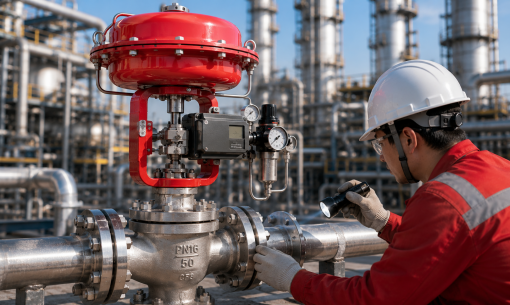
Unexpected valve failures can lead to production downtime, reduced efficiency, safety risks, and increased maintenance costs. Understanding the most common control valve problems and their causes is essential for improving reliability and extending equipment life.
In this article, we examine the most frequently encountered control valve failures and discuss practical strategies to prevent them.
Leakage is one of the most common control valve problems. Internal leakage occurs when the valve fails to achieve proper shutoff, while external leakage may occur around packing, gaskets, or body connections.
Common causes include seat wear, damaged sealing surfaces, incorrect material selection, and excessive operating pressure.
Preventive measures include selecting appropriate trim materials, performing regular inspections, and ensuring the valve is sized correctly for the application.
Cavitation occurs when liquid pressure drops below its vapor pressure, creating vapor bubbles that collapse violently inside the valve. This phenomenon can rapidly damage valve trim and internal components.
Signs of cavitation include unusual noise, vibration, and accelerated wear.
Applications with large pressure drops may benefit from specialized flow control designs for severe service conditions that help reduce cavitation effects.
Vibration can shorten equipment life and negatively affect control accuracy. It often results from improper sizing, turbulent flow conditions, excessive pressure drop, or unsuitable valve selection.
Persistent vibration may damage actuators, positioners, and internal trim components.
Proper valve sizing and the use of engineered control valve solutions can significantly reduce vibration-related issues.
The actuator is responsible for positioning the valve according to control signals. Failures may occur due to air supply problems, electrical issues, worn components, or poor maintenance practices.
Symptoms may include slow response, inaccurate positioning, or complete loss of valve movement.
Regular inspection of pneumatic systems, positioners, electrical connections, and feedback devices can help prevent unexpected actuator failures.
Improper sizing remains one of the leading causes of control valve performance problems.
An oversized valve often operates near the closed position, reducing control accuracy and increasing seat wear. An undersized valve may struggle to provide sufficient flow during peak operating conditions.
For applications involving significant pressure differential, a pressure-balanced control valve configuration may improve stability and operational performance.
Corrosive media can gradually damage valve bodies, trim, seals, and actuators. Material degradation often results in leakage, reduced performance, and premature failure.
Selecting appropriate materials based on media composition, temperature, and pressure conditions is essential for long-term reliability.
Industries such as fine chemical processing often require special attention to corrosion resistance and material compatibility.
Control valves operating under high pressure face additional challenges, including trim erosion, vibration, and sealing difficulties.
Applications involving severe pressure conditions often require engineered solutions designed specifically for high-pressure service.
Products developed for high-pressure flow control applications can help improve reliability and reduce maintenance frequency.
Preventive maintenance remains the most effective strategy for minimizing valve failures.
Recommended practices include:
• Conduct regular inspections.
• Verify actuator performance and calibration.
• Monitor pressure drop and flow conditions.
• Replace worn trim and sealing components promptly.
• Review valve sizing whenever process conditions change.
Working with experienced engineering teams can further improve system reliability throughout the valve lifecycle.
Control valve failures are often preventable when proper selection, sizing, installation, and maintenance practices are followed.
By understanding common issues such as leakage, cavitation, vibration, actuator problems, and corrosion, plant operators can reduce downtime and improve process efficiency.
More News

RELATED PRODUCTS
Security is not only the future value of YSMETER, but also the core interest that YSMETER brings to customers

YSIQ(D)20 Pressure-Balanced Single-Seat Control Valve
This valve adopts a modular design with high versatility and interchangeability, and features a compact structure.
View More
YSIQ(D)60 Intelligent Single-Seat Angle Control Valve
The valve features a modular design with strong universality and interchangeability, offering a compact structure.
View More
YSIQ(D)70 Intelligent High-Pressure Control Valve
The YSIQ(D)70 series pneumatic/electric intelligent high-pressure control valves feature a unique design and special hardening treatment
View More
ZZYP Self-Operated Pressure Control Valve
The ZZYP series self-operated pressure control valve is an actuator product that requires no external power source
View More
ZZVP Self-Operated Micro-Pressure Control Valve
The ZZVP series self-operated micro-pressure control valve is an actuator product that requires no external energy source
View More